Wandermio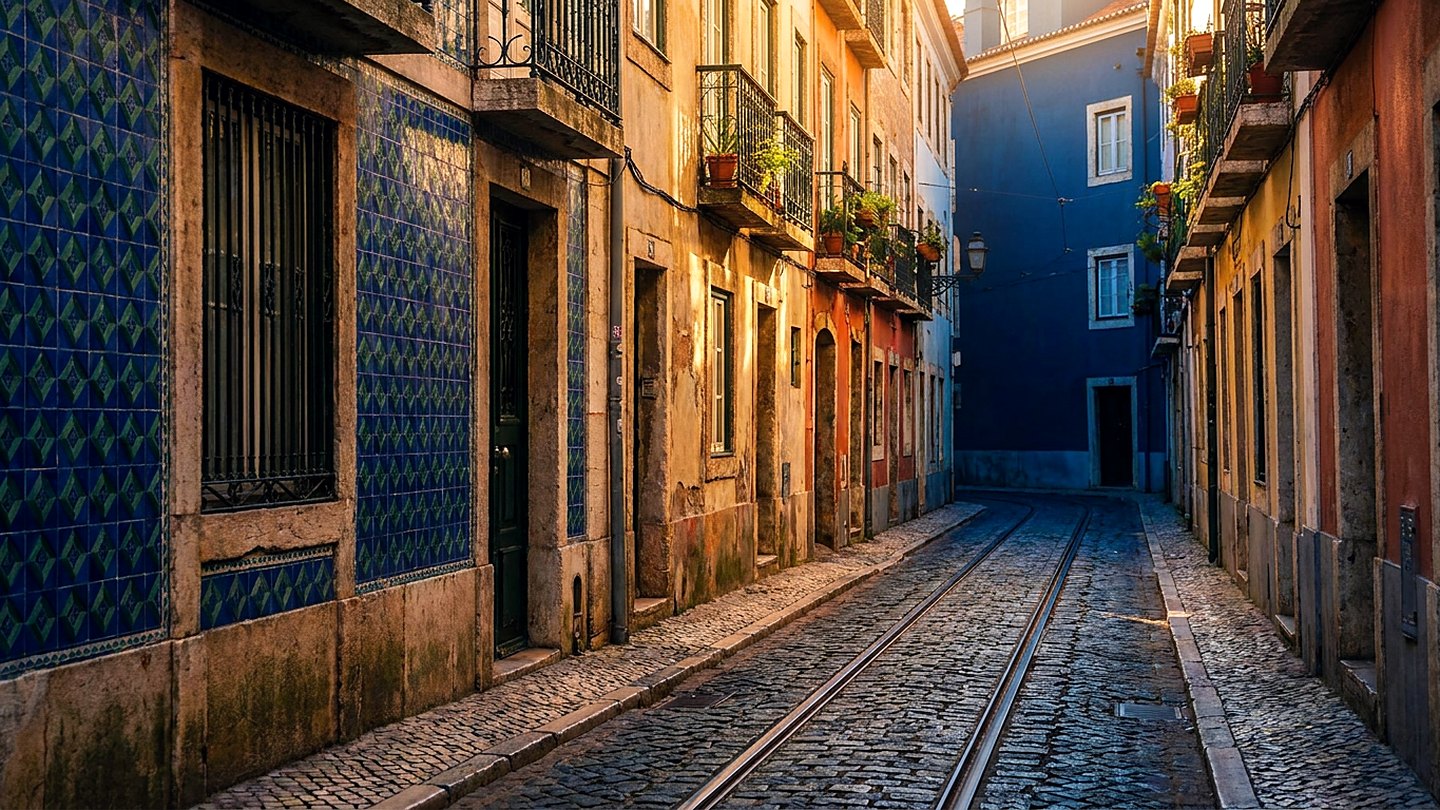
Tile Hunting in Lisbon, One Facade at a Time
I came to Lisbon in April with a loose plan and one good pair of shoes, and I went home with more pictures of walls than of anything else. Not the famous walls, either. Ordinary ones. The side of an apartment building on a street I could not find again if I went looking, tiled from the second floor up in a blue and white pattern that repeats about every hand width and has been repeating there since somebody's great-grandmother moved in.
The word is azulejo, and once I started noticing them the city quietly rearranged itself. Streets I had already walked twice turned into new streets. I stopped reading Lisbon as a set of viewpoints with a river at the bottom and started reading it as one very long, very patient wall that happens to have a city attached.
What the tile is actually doing
I assumed at first that the tile was decoration and nothing else. It is not. Glazed tile sheds rain, and Lisbon takes a lot of rain in the wet months, arriving sideways off the Atlantic. It keeps water out of the plaster underneath. It throws heat back in August instead of holding it. It cleans up with a bucket and a rag, which matters on a hill where every surface collects grit from the street above it.
So the beauty is a side effect of a sensible decision, made over and over for two hundred years. That is my favorite kind of beauty. Nobody woke up planning to make the sixth floor of a plain building on a plain street lovely. Somebody set out to keep the wall dry, and lovely happened on the way.
Once I understood that, I quit hunting for grand panels and started looking at working tile. A single facade often carries three or four generations at once: the original field, a patch from a repair somebody made in the nineteen fifties, a modern reproduction where a balcony came down and went back up, and a stretch of bare cement where the work simply stopped.
Somebody set out to keep the wall dry, and lovely happened on the way.
Alfama and Graca, early
A pattern only shows up when the sun comes at the wall from the side. At noon a glazed facade behaves like a mirror. It goes white and flat, and the camera hands back glare. Low light rakes across the surface, picks up the slight curve in each tile, and the whole thing turns into texture. That single fact reorganized my week.
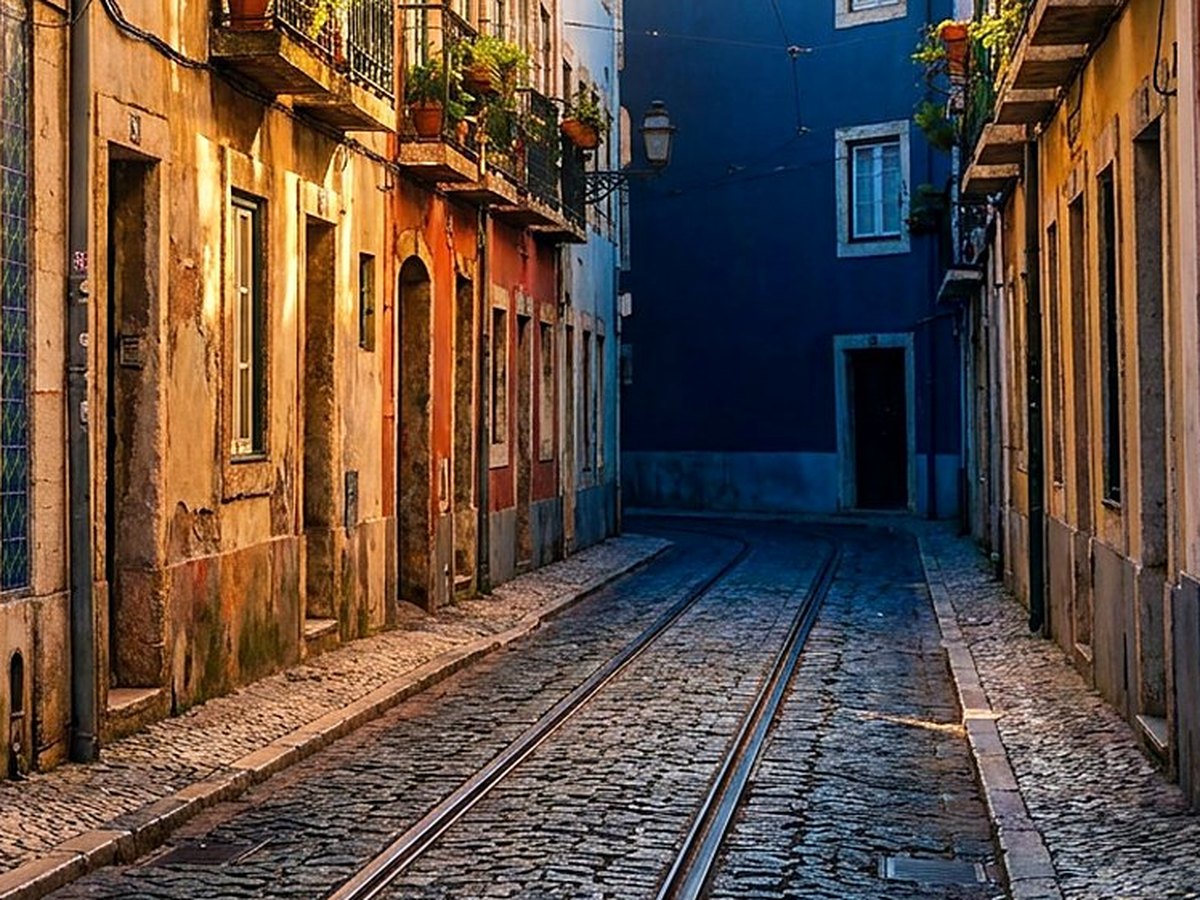
So: mornings on the eastern side of the hills. I would come up out of the low streets near the river around half past seven, when the delivery vans are still double-parked and the cafes smell like steamed milk and floor cleaner, and work uphill through Alfama with the sun behind my right shoulder. The lanes there are narrow enough that light arrives in slabs. A given wall holds its angle for maybe forty minutes, which sounds stressful and is actually the opposite. It gives the walk a shape.
Graca sits above Alfama and takes the light a little later, so the two stack neatly. By nine I would be at the viewpoint under the pines with the whole city laid out below, the river the color of weak tea, the roofs going from gray to warm. Then I would come down a different way and find a street I had missed.
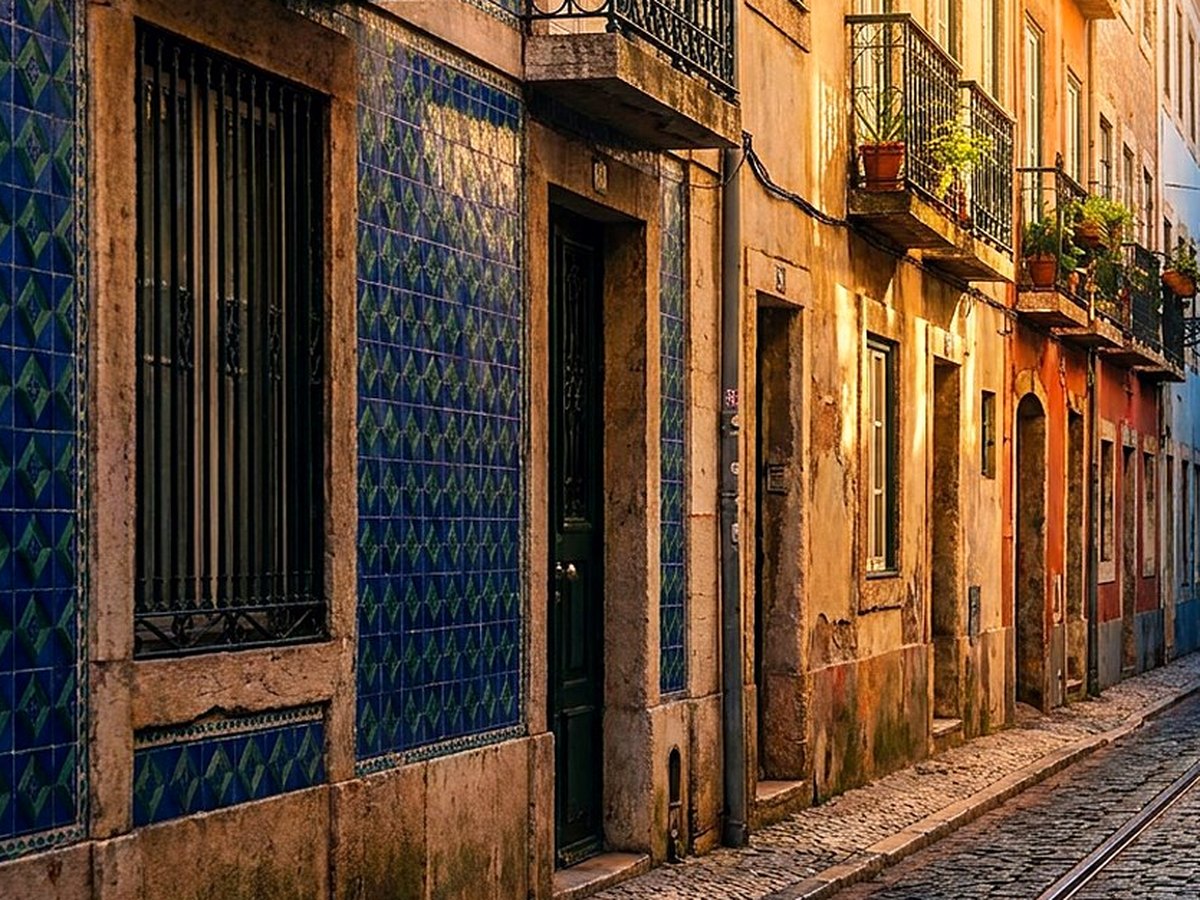
Afternoons I crossed to the western hills, where the fronts face the other direction. Principe Real, the top of Bairro Alto, the long streets running out toward Campo de Ourique. Same trick, opposite hour. It took me three days to stop fighting the middle of the day and simply put it somewhere else: a long lunch, a slow ride out along the water, a sit in a square with a paper.
The colors that gave up
What I did not expect to love was the failure. Tile ages badly in a beautiful way. Cobalt fades toward a chalky, grayish blue. Yellow drifts green. The glaze crazes into a web of fine cracks, then a corner lifts, then a whole tile falls and leaves a pale rectangle of mortar with the old adhesive combed across it in ridges.
Then somebody patches it, and the patch is never right. It is a shade too bright, or the pattern sits a half-step off, or the scale is wrong and a floral repeat runs straight into a geometric one. On one building near Anjos I found five patches in a single wall, each from a different decade, and the effect was less like damage than like a sweater mended by five people who all loved the person wearing it.
Rain streaks help. Under every balcony there is a vertical stain where water has been running off the same corner for eighty years. Salt haze from the river dulls the lower floors and leaves the upper ones brighter, so whole buildings look like they are wading. Once I saw that gradient I saw it on every street.
Reading a facade
After a few days I could read a wall the way you read a paragraph. There is the field, the repeating pattern that covers most of the surface. There is the border, a narrower strip that frames it and turns corners with special pieces. There is often a panel above the door, larger and pictorial. On street corners you sometimes find a small saint set into the plaster with a lip of stone above him to keep the weather off.
The oldest field patterns I saw were simple: one blue motif on white, four tiles making a single unit, so the eye assembles a shape bigger than any one tile contains. Later ones get busier, with relief pressed into the surface so they catch light even on a flat gray day. The nineteenth century brought entire streets of them, because a factory could turn out tile faster than a mason could carve stone, and a building going up fast could still look dressed.
I liked the plain ones most. A single color, slightly uneven glaze, laid across four floors, doing its job. Up close every tile is a little different. From across the street they add up to one calm surface. That is a decent description of a good week of travel, now that I write it down.
When to go, how to move, and what sits nearby
Spring is kind here. April and May give long light, mild afternoons, and enough passing rain to wet the walls, which deepens the color for an hour afterward. October does the same thing in reverse. Midsummer is bright and hot, the sun sits too high for too long, and the low streets fill up. Winter is soft and gray and the tile goes quiet, though the rain does make everything shine.
I moved on foot almost the whole week. Lisbon is seven hills and every one of them repays the climb, but the climbs are real, so I leaned on what the city built for them. The funiculars up the western slopes save your legs. Public stairways and lifts cut through blocks that look impossible on a map. The old trams handle the tight lanes better than anything modern, and they are slow in the good way. Trains along the river run east toward the industrial edges and west toward the coast. I never once needed a car, and parking on those streets looks like a hobby for the very patient.
For more tile than any street can hand you, the national tile museum sits east of the center in an old convent, and the cloister alone justifies the ride out. Belem is west along the water, easy by tram or train, with the monastery and a long stretch of riverfront to walk off lunch. And when I wanted green after all that stone, the hill towns behind the city were forty minutes out by train, wrapped in mist most mornings, full of gardens that make the whole coast look like somebody's private idea.

Ida Fenwick
Writes and photographs this blog from Charleston, West Virginia. More about the blog.
Read next
-
Seven Days on Iceland's Ring Road, Early Summer
Last June I drove the whole loop in seven days and learned that the driving was not the space between the good parts. It was the good part.
-
Kyoto at Six in the Morning, Before the Gates Open
Eleven early spring mornings of mist on the canal, wet moss, and wooden streets with nobody in them. The alarm feels like a mistake for about ninety seconds.